Power over Ethernet times Endpoints equals Smart, Sustainable Networks
The pursuit of a perfect Smart Hospital is often deified, when perhaps our attention should be on continual improvement and evolution. One always finds one’s burden again, and here it’s about building the right digital foundation.
For much of the last thirty years, the role of the network in a hospital has been remarkably simple: connecting people, systems and devices. It has become so reliable that, like running water or electricity, we rarely think about it at all anymore, and IT teams have done a jolly good job of making sure that was so.
Instead of just transporting information and data, the network started transporting power too. That has the potential to fundamentally change how we design, operate and continually adapt healthcare environments.
Enhancing the PoE Case
Power over Ethernet (PoE) has been used to power wireless access points, IP telephones, CCTV cameras and countless other devices for years. Is it useful? Absolutely. Is it transformational? Probably not. It is tempting to conclude that all is well.
However, what happens when we stop thinking about individual devices and start thinking about entire environments?
Imagine a consultation room where the monitors, collaboration endpoint, task lighting, USB charging and workstation are all powered and managed by the network.
Imagine spaces that can be spun up and reconfigured without extensive electrical work.
Imagine being able to automatically test emergency devices centrally rather than have staff do it manually.
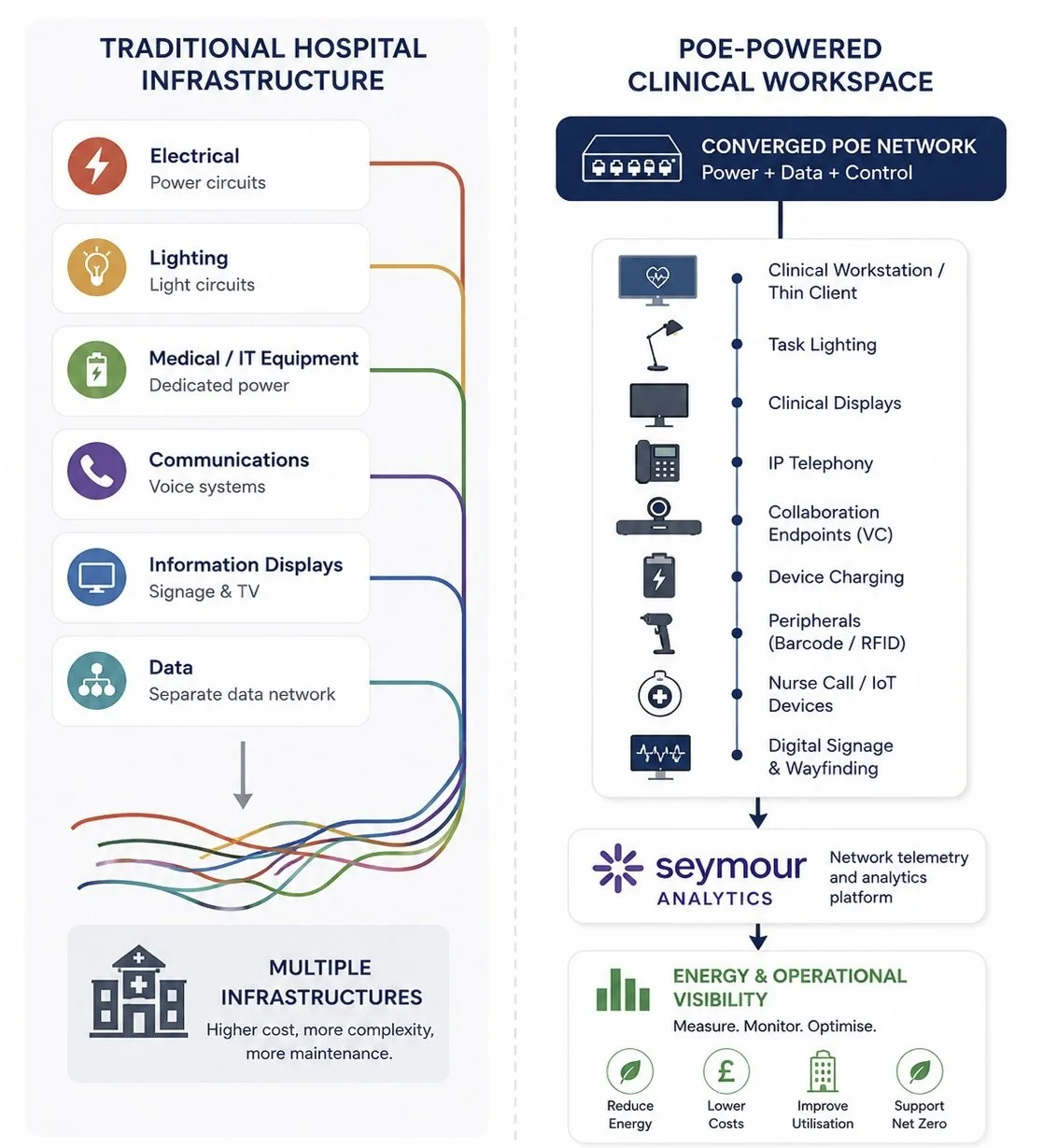
Now consider that concept repeated hundreds or thousands of times across the hospital estate. Or… Imagine the amount of power being delivered by the network being more than the current 90W and able to power entire networks rather than individual devices. One must imagine the Hospital learning.
More Convergence, More to Consider
This approach teaches the higher fidelity that negates the myth of the ‘finished’ Smart Hospital and raises the continual, evidence-based work of ‘improvement’. Just as voice and data converged in the early 2000s and data, voice and video in the late 2000s, as does OT, IoT, sensors and power systems in a more wholesale manner now.
Every technology that moves onto the network is more than just another powered device; it is another intelligent endpoint to be monitored, managed, secured, measured and optimised. The energy consumption, operational status and utilisation for all of this suddenly become visible… but what does that mean?
For clinical teams, it means safer, more adaptable environments that can evolve alongside changing models of care.
For estates teams, this creates opportunities to reduce infrastructure complexity, automate maintenance processes, and reduce costs associated with AC-delivered power to workstations, lighting, wall sockets etc.
For digital teams, it extends the intelligence of the network far beyond traditional IT, allows cleaner network segregation and securing of critical data, adds resiliency and speed up failover times for critical workspaces.
For sustainability teams, it directly helps meet ESG commitments, introduces new levels of visibility into how energy is consumed, not simply at a building level, but by individual workspaces, departments and technologies.
In other words, capabilities that traditional electrical infrastructure was never designed to provide, and some designs and technologies are not able to carry forward, and thus we leave healthcare at the foot of the mountain.
Ideal’s First PoE Workspaces
At Ideal, we’ve recently delivered the UK’s first commercial deployment of fully PoE-powered workspaces outside a vendor demonstration environment for a globally recognised health research organisation.
The project itself wasn’t designed to prove a point, it was to solve a practical challenge. Power and connectivity were delivered through the same Ethernet cables to the desktop shown here, comprising displays, lighting, laptop and height-adjustable desk.
Yet the outcome has pointed at something much larger: the workplace itself became part of the digital infrastructure.
The workspace became measurable, manageable and adaptable. To help understand the operational data being generated, Seymour, Ideal’s own telemetry and analytics platform, visualises energy consumption, utilisation and device health, and aids troubleshooting, turning connected workspaces into a continuous source of operational insight.
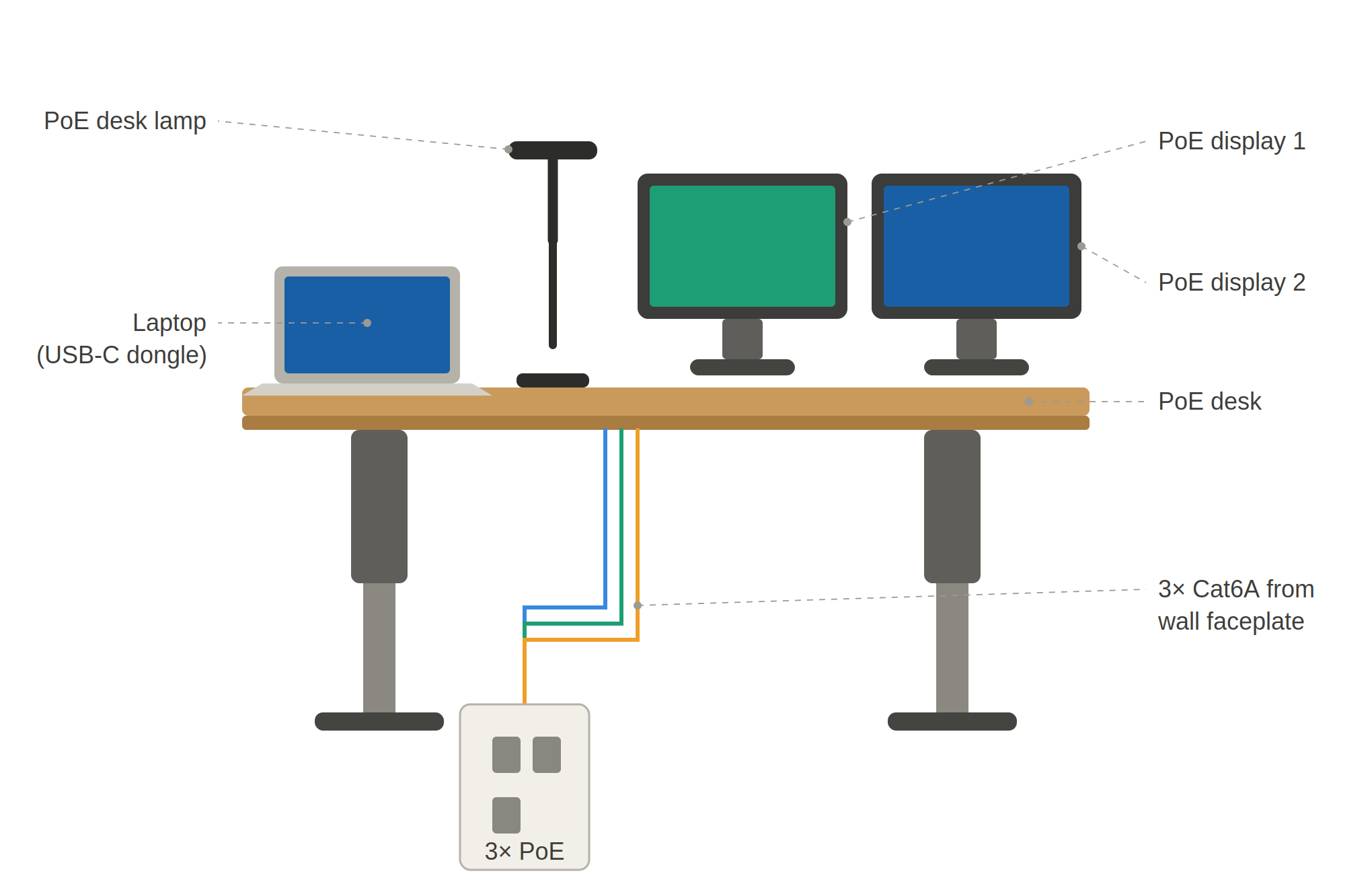
Perhaps most importantly though, these workspaces have been designed and built for whatever comes next, namely Fault Managed Power (FMP) - an emerging technology that safely distributes significantly higher levels of DC power over structured cabling. This will take us from 90W with PoE to 600W, and from powering single devices to entire 48-port network switches, in the safest and most sustainable way. It’s pretty easy to imagine the same principles being applied to consultation rooms, nurse stations, education facilities, administrative areas and multidisciplinary team spaces across the healthcare estate.
Learning A Valuable Lesson
A truly Smart Hospital will emerge through the convergence of hundreds of technologies working together. IHC, OBS, call it whatever you like, we’re talking about clinical use cases which rely on digital technology to deliver. In order to understand the world, one has to turn away from it on occasion, and learn from validated technologies deployed elsewhere.
What surprised us about that first workspace wasn’t that it could be powered over Ethernet… We already knew that was technically possible. It was how quickly the conversation stopped being about power and became about adaptability, operational insight and the role of the network itself. We didn’t build a smarter desk, we discovered a smarter network.
Network-powered devices, displays, lighting and infrastructure all belong in exactly the same conversation. Not because a powered device changes healthcare, but because it changes the capabilities of the infrastructure supporting healthcare. Every additional intelligent endpoint strengthens the digital foundation upon which future services can be built.
You’ve heard of a Teaching Hospital. This is the Learning Hospital
Perhaps the most significant advantage of bringing powered workplaces onto the network is that every display, collaboration endpoint and/or connected device becomes another source of operational intelligence, creating a continuous stream of information from which the hospital itself can learn:
Which workspaces are consuming the most energy?
Which devices are consistently generating faults?
How does utilisation vary throughout the day, week or season?
These are questions that traditional electrical infrastructure was never able to answer.
When you’re trying to improve operational efficiency, resilience and sustainability, that insight becomes just as valuable as the infrastructure itself. Rather than showing that devices are powered, network telemetry visualises energy consumption, asset location and movement, utilisation patterns and device health, while providing the information needed to resolve critical issues more quickly.
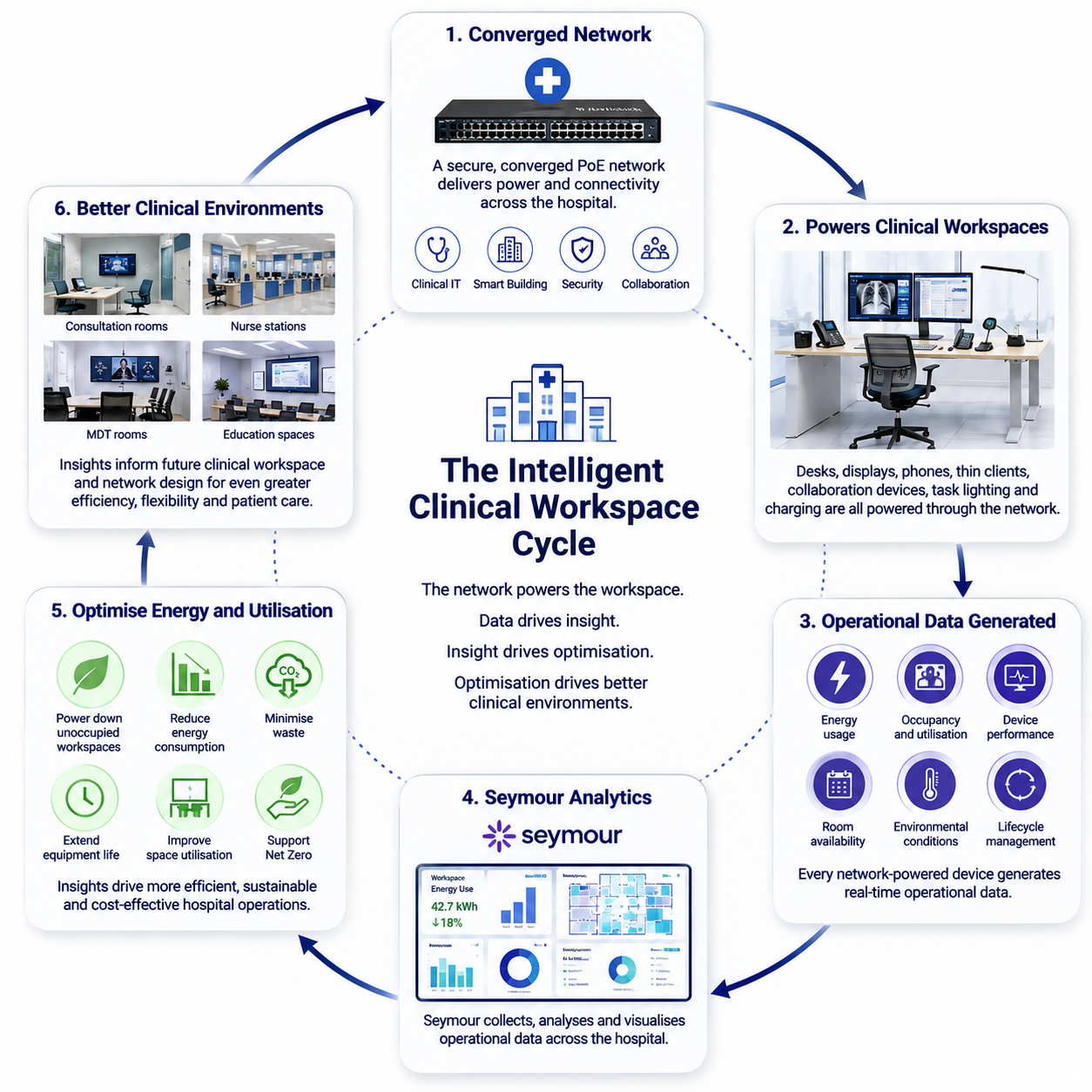
Each datapoint of that intelligent powered endpoint, each insight revealed by that converged network, becomes a world in itself. The struggle towards improvement is enough to fill a man’s heart, because tomorrow’s hospital should always be better than today’s.
Smart Never Stops
Hospitals have traditionally been designed around electrical infrastructure, with the network providing connectivity alongside it. Increasingly, that relationship is being reversed, we need to be careful this continues.
Thinking differently about the network requires accepting that there is no final Smart Hospital. No point at which the work is complete. The value lies in continually making the environment safer, more efficient and more adaptable than it was yesterday. That means convergence, security, and centralised reliability and control.
Seeking what is true is not seeking what is desirable, it’s drawing on evidence to produce the right choice for an ever-changing situation. The hospital of the future won’t simply be connected by the network, it will be powered, informed and continuously improved by it.